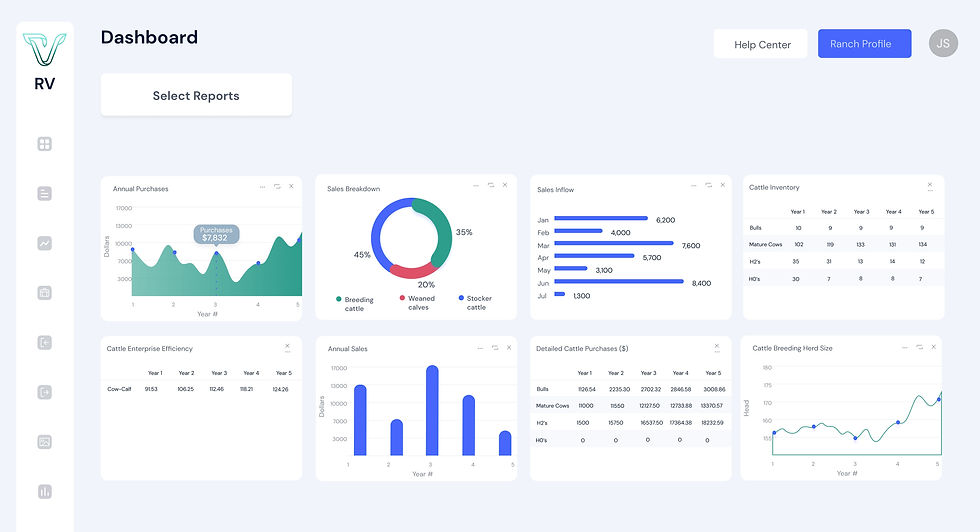

Quick answer: Compare your replacement cost with the market price. If raising a bred female costs less than buying a comparable one, raise your own. If you can buy for less, buy. Ranch Vision's Replacement Costs reports total every real and opportunity cost of raising an H1, E1 or D1 to two months pregnant, so the comparison is fair.
Do you know whether it costs more to raise breeding replacements for your ranch herd, or to purchase them?
Efficient ranch management hinges on understanding and controlling the costs associated with raising breeding replacements.
The Replacement Costs reports from Ranch Vision provide essential insights into these expenses, enabling ranchers to make informed decisions about their breeding strategies.
With just a few simple inputs about your ranch program, Ranch Vision will give you the financial breakdown on whether you should RAISE or PURCHASE future breeding replacements for the ranch.
These reports contain detailed projections for the costs associated with raising female breeding replacements under the current management plan, focusing specifically on the costs involved in producing an H1, E1, and/or D1 that is two months pregnant.
Should I buy or raise breeding replacements for my ranch?
The ultimate goal of Replacement Costs reports is to provide ranchers with the data they need to answer a critical question: “Should I be raising my own breeding replacements or purchasing them elsewhere?”
By analyzing the detailed cost projections, ranchers can determine the most cost-effective strategy for their operations.
-
When to Raise Breeding Replacements: If the projected Replacement Cost is lower than or comparable to the market price for purchasing breeding females, it makes sense to raise replacements in-house. This approach can ensure better control over the quality and health of the breeding stock.
-
When to Purchase Breeding Replacements: Conversely, if comparable or superior breeding females can be purchased at a price below the projected Replacement Cost, it would be more economical to buy them. This strategy can free up resources and reduce the financial burden associated with raising replacements.
Comprehensive Cost Projections for Your Ranch Breeding Program
Using your Ranch Vision dashboard, you can make informed decisions for your ranch.
Your Replacement Costs reports provide a comprehensive overview of all real and opportunity costs involved in raising breeding replacements.
Ranch Vision examines all relevant factors when generating your Replacement Costs reports. This detailed analysis includes:
-
Opportunity Costs: One of the significant factors in these projections is the opportunity cost of not selling a female at weaning. Instead of immediate revenue from selling, the ranch invests in the animal's growth and future breeding potential. This investment must be carefully weighed against potential returns from immediate sales.
-
Capital Investment: Raising breeding replacements requires substantial capital investment. This includes the initial purchase price or the valuation of the animal at birth and ongoing costs for feed, veterinary care, and other necessities to ensure the animal's health and growth.
-
Grazing Fees: Grazing is a crucial element of the cost structure. The reports account for the expenses related to providing adequate pasture for the breeding replacements, including land maintenance and any associated grazing fees.
-
Maintenance of Breeding Males: The costs of maintaining breeding males are also considered. This includes their feed, health care, and overall management to ensure they remain in prime breeding condition. You can't make a smart decision about purchasing or raising female breeding replacements, from an economic standpoint, without also considering the costs of maintaining breeding males.
-
Expected Losses: Inevitably, your ranch herd will experience losses due to death, infertility, and culling. These potential setbacks are factored into the overall cost projections, providing a realistic estimate of the financial commitment required.
-
Direct Costs: The reports cover both cash and non-cash direct costs. This includes out-of-pocket expenses such as feed, supplements, and veterinary services, as well as non-cash costs like depreciation of equipment used in the breeding process.
-
Value Offsets: To balance the costs, the reports also consider the offsets received from the sale of cull and open animals and possible byproducts like wool and mohair. These offsets help to mitigate the overall expense of raising breeding replacements.
As you can see, this is not a simple cost-benefit analysis comparable to those performed by other businesses. The ranch business has many hundreds of unique, interrelated factors, and of course, every single ranch business is unique. Ranch Vision calculates for all of your ranch's unique factors, controlling for all variables, in order to provide you with dependable, comprehensive reports customized to your ranch business.
Example Ranch: Breeding Replacement Reports
Let’s check out an example of the Replacement Costs reports.
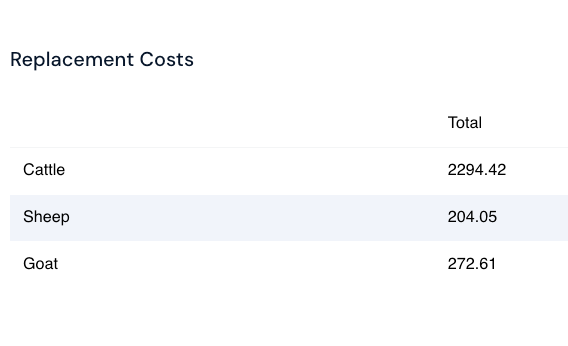
Before Fred and Jenny at the Lazy B purchased breeding replacements for the coming year, they logged into their Ranch Vision account and checked their Replacement Costs reports:
-
For their cattle enterprise 🐂, they immediately realized that at the going rate of $2,250 each for bred H1s they would do better to raise their own at the current cost of only $2,033.35.
-
Likewise for their goat enterprise 🐐, they are better off raising their own bred D1s for only $171.70 each as compared to the current market price of $245 for comparable bred does.
-
However, for their sheep enterprise 🐑, it would be advantageous for them to purchase bred replacement ewes which they could do at $265 each when compared to the cost of $334.19 each if home-raised.
Conclusion
Ranch Vision's Replacement Costs reports are an essential tool for ranchers seeking to optimize their ranch breeding program strategies. By providing a detailed analysis of all costs involved in raising breeding replacements, these reports empower ranchers to make data-driven decisions that enhance profitability and operational efficiency.
Whether raising or purchasing breeding replacements, having access to comprehensive cost projections ensures that ranchers are able to confidently choose the best path for their business.
To help understand how to use the Replacement Costs reports effectively, watch our detailed video example demonstrating the process step-by-step.
Frequently asked questions
Should I raise or buy replacement heifers?
Raise them if your cost to produce a bred heifer is lower than or close to what a comparable bred heifer sells for. Buy them if you can purchase comparable or better females for less than your replacement cost. The same test works for ewes and does.
What costs go into raising a breeding replacement?
The opportunity cost of not selling her at weaning, the capital tied up in her, grazing, her share of the cost of keeping bulls, rams or bucks, expected losses from death, infertility and culling, and cash and non-cash direct costs. Sales of culls and opens, and wool or mohair, offset part of the total.
Why include the cost of keeping bulls?
A replacement female has to be bred, so the breeding males are part of what she costs to produce. Leaving them out makes raising your own look cheaper than it really is.
Does this work for sheep and goats?
Yes. The reports cover H1 heifers, E1 ewes and D1 does. In the Lazy B example above, raising their own was cheaper for cattle and goats, but buying was cheaper for sheep.
Find out whether you should raise or buy your replacements. Start a free 14-day trial (no credit card required), or join Dr. Brazil for a live walkthrough.