

In this video, Dr. Rich Brazil discusses the concept of cow depreciation.
Most cow-calf operations sell a cow when she's done: bad udder, lame, open, or weaning a light calf. By then she brings butcher-cow money. What if you sold her at 4 or 5 years old instead, while she's bred and worth the most?
On one West Coast ranch, that change was projected to raise profit 39% in year one and about $78,000 over five years. On the same ranch, a $400 drop in bred-cow price wiped most of that out.
Here's how to find out which side of that line your operation falls on before you change anything.
What managing for cow depreciation means
A breeding cow climbs in value as she comes into production, plateaus, then loses value every year after. Managing for cow depreciation means selling her near the top of that curve, around 4 to 5 years old, instead of riding her down to cull price.
Grazing consultants such as Wally Olson and John Haskell have talked about this for years. They suggest a cow-calf enterprise run this way earns from two income streams, calves and young bred cows, as opposed to just one.
It can feel backward. You spend years and money developing a heifer, eat the death losses and open heifers along the way, then sell her the moment she starts paying. Whether that trade works depends on your cost structure, and that is a question for the numbers, not your gut.
Setting up the scenario
Dr. Brazil starts with a fall-calving West Coast ranch already entered in Ranch Vision as its current plan. He creates a new scenario called "Depreciation Plan." In the program, creating a new scenario copies every input so only the changes need entering. Then you can run a direct comparison. For this example, three inputs change:
- Sale price for mature cows. Instead of about $1.45 a pound as culls, the young bred cows are priced at $3.33 a pound. At 1,200 pounds, that is $4,000 a head.
- Cull rate for mature cows. Raised to 50%, so half sell at 4 and the rest at 5. Selling everyone at 4 would be 100%; spreading sales across ages 4 to 6 would be 33%.
- Replacements. With half the mature cows leaving each year, the herd shrinks unless heifers come in. This ranch buys weaned heifer calves at $2,400 a head rather than keeping more of its own. In the U.S., purchased breeding stock can be depreciated for tax purposes while ranch-raised animals cannot; check with your tax advisor.
How many heifers to buy? Dr. Brazil tries 30, then 35, then 36, checking the herd inventory and grazing demand reports each time. At 36 purchased heifers, grass use matches the current plan almost exactly, so the comparison is apples to apples.
The results: two income streams and more profit
At $4,000 bred cows and $2,400 heifers, the depreciation plan beats the current plan on every report Dr. Brazil compares.
Gross margin. The cow-calf enterprise's gross margin rises from $214,000 to $243,000 in year one, $222,000 to $230,000 in year two, and $228,000 to $244,000 in year three.
A second income stream. Calf sales in September, November, and April stay the same. A new block of income shows up in May, when the young bred cows sell. Then the ranch sees a new expense in July, when the replacement heifers are bought.
Cash flow. Year-one income rises from $763,000 to $976,000 while outflow rises from $410,000 to $496,000. Net cash flow goes from $353,000 to $480,000. In year two it goes from $400,000 to $430,000.
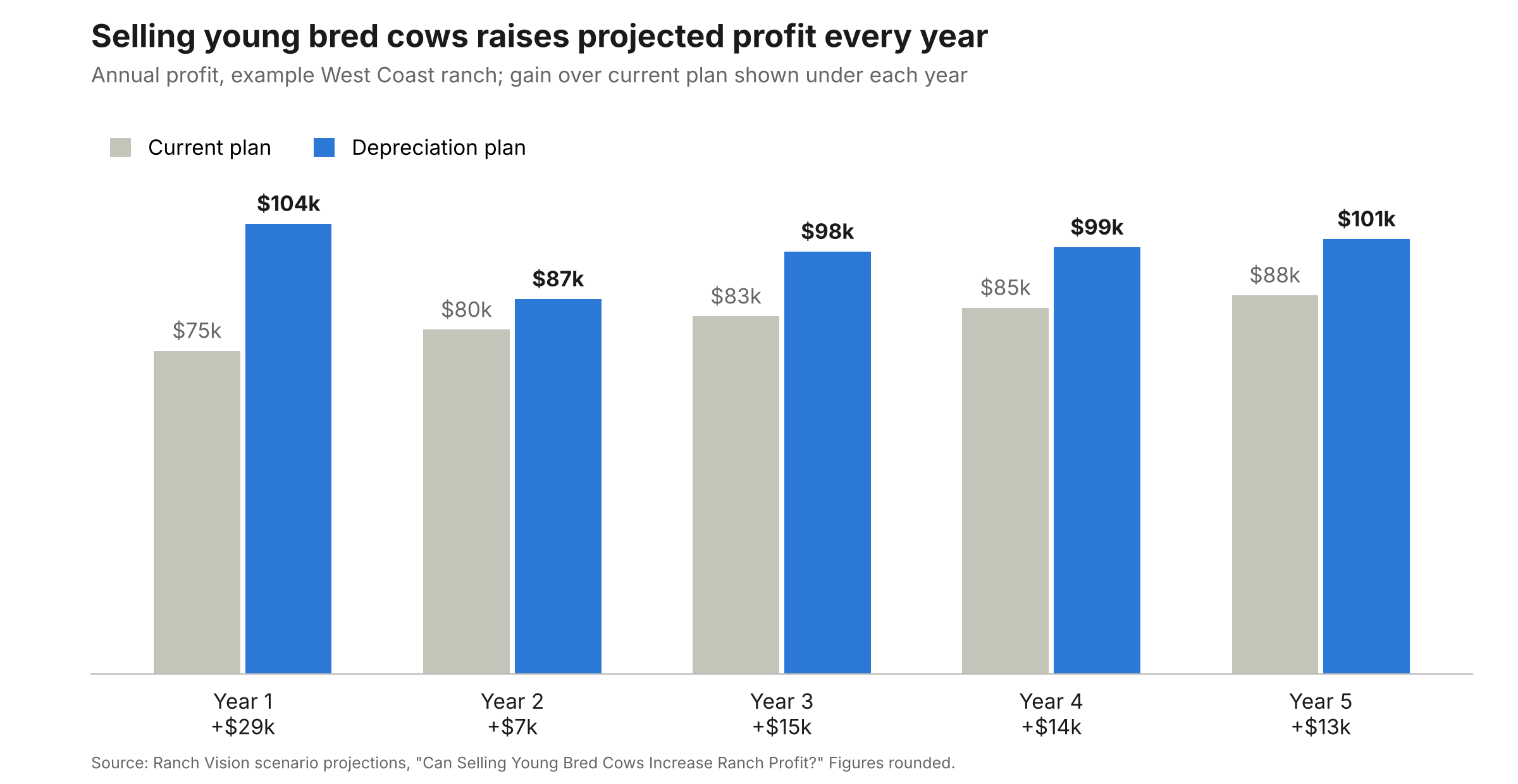
Profit. Year one jumps from $75,000 to $104,473, a 39% increase. The gain settles at 15% to 18% in years three through five, about $78,000 more profit over five years.
What changes on the ranch level
Another thing to consider: Under this plan, you'll be running a different ranch. In year one of the current plan, the breeding herd has 122 mature cows and 27 first-calf heifers. Under the depreciation plan, the number of first-calf heifers roughly doubles in later years.
More heifers calving means rethinking bull selection for calving ease, calving labor, and your calving plan. Those costs should be included in the model before you commit to a whole new ranch operation.
When it doesn't make sense
The same ranch, with two numbers adjusted, tells an entirely different story. Dr. Brazil builds "Depreciation Plan 2" with identical changes, except for price:
- Bred cows bring $3,600 instead of $4,000 ($3.00 a pound). Profit roughly breaks even with the current plan: a little ahead in years one and three, a little behind in years two, four, and five.
- Add heifers at $2,600 instead of $2,400. Now the strategy loses money.
A $400 swing on one side and a $200 swing on the other turn a 39% gain into a loss. Your conception rates, weaning rates, death loss, and expected prices all move that line, which is why nobody else's example can answer it for you. You need to run a Ranch Vision scenario to really get an idea of what this change will look like and how it will impact you.
Run it on your own ranch
Selling young bred cows can raise profit 20% to 40% on the right operation and lose money on the wrong one. The only way to know which you run is to put in your own numbers and compare.
Ranch Vision builds a five-year model of your operation and lets you test this decision side-by-side with what you're doing now: herd numbers, grazing demand, cash flow and profit, before you sell a single cow.
Plan to Profit. Start your free trial: free for 14 days, no credit card.